The blizzard of 1960
 |
|
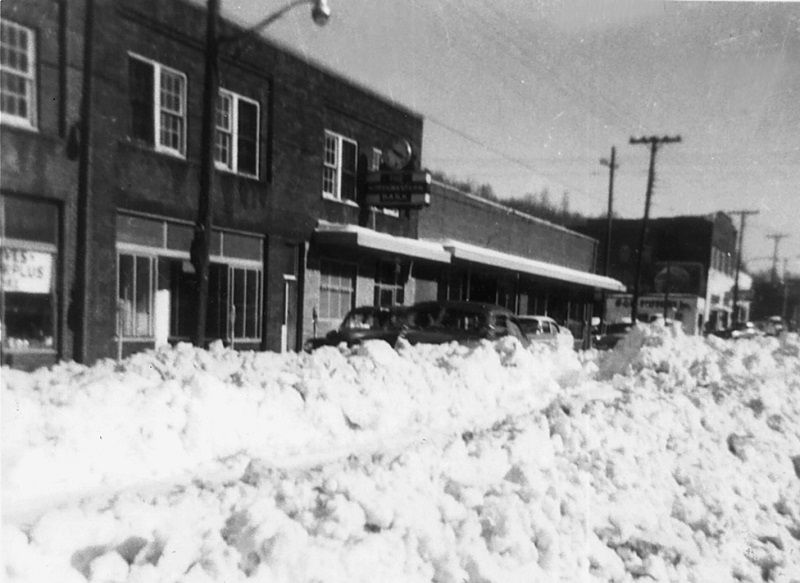
South Jefferson Avenue in downtown West Jefferson, March 1960. | Museum of Ashe County History
|
By the first weeks of March 1960, Ashe County was into its fourth consecutive week of snow. Starting around the middle of February, the white stuff fell up to 14 to 18 inches at a time.
Stella Anderson, editor of the Skyland Post, the local newspaper of the day, rose to action and telegraphed the office of NC Governor Luther Hodges for help. She specifically requested a “large rotary road scraper with blower.”
Helicopters regularly landed and took off from the old ball field next to where the Ashe County Library sits now. They dropped food packages, bags of coal, and bales of hay for livestock all over Ashe, Alleghany and Watauga counties. The outside media picked up the story, and it morphed into a major humanitarian crises.
Some who had food packages dropped on their property walked to Duvall’s Grocery store on Jefferson Avenue to exchange the goods in their package for some other brand or product they preferred. “They dropped us hotdogs, and we wanted wieners,” complained one housewife, as she plopped her parcel on the counter. Owner Bernice Duvall politely made the exchanges.
Others reported that bales of hay dropped by helicopter landed on their livestock, killing more than one cow. A food package dropped at one farmhouse hit one of the owner’s prize cherry trees, tearing the tree to bits. Outraged, the owner grabbed his gun and fired off two rounds of No. 8 (bird shot) at the retreating helicopter.
Dr. Carson Keys and nurse Betty Ball were recruited from Ashe Memorial Hospital to fly in by helicopter to check on a couple living near Whitetop. The old man and his wife had no way of knowing company was coming from the sky, so when the noisy helicopter set down in their apple orchard, the woman dropped to her knees in the front yard and began to pray. Her husband ran for the barn to fetch his shotgun. Dr. Keys joked it was the last time he would be the first one off a helicopter.
Evelyn Jones of Jefferson said one fellow, who lived and worked tending cattle up around Grayson Highlands, made it into town for supplies. When the National Guard heard he had come from so far away, they offered him a ride home on a wiesel, a big piece of heavy equipment brought in to move snow. “Lord no!” He answered, horrified. “I got chickens up there!”
Most locals have heard the story about Red Cross workers hiking up to an elderly woman’s cabin, a long way from anywhere. They saw no footprints coming or going from the cabin, so they knocked on the door to see if the occupant was in need of help. The door opened a crack against the cold, and the workers introduced themselves.
At one point during the snow event, Governor Hodges made a trip to Ashe County to see what was going on first hand. Doris Oliver recalls West Jefferson, command central for the military and Red Cross, was besieged by people coming into town to see the governor. With only limited lanes cleared and snow heaped everywhere, traffic was snarled and parking was near futile. “We probably didn’t make a very good impression on the governor,” said Oliver.
Finally, by the second week of March, the snow stopped; there was 32 inches on the ground in Jefferson. Handwritten reports from the Jefferson weather station documented the level of precipitation each day and were submitted to the station in Huntington, Virginia throughout the event. The reports are on file in the archives of the National Oceanic and Atmospheric Administration (NOAA).